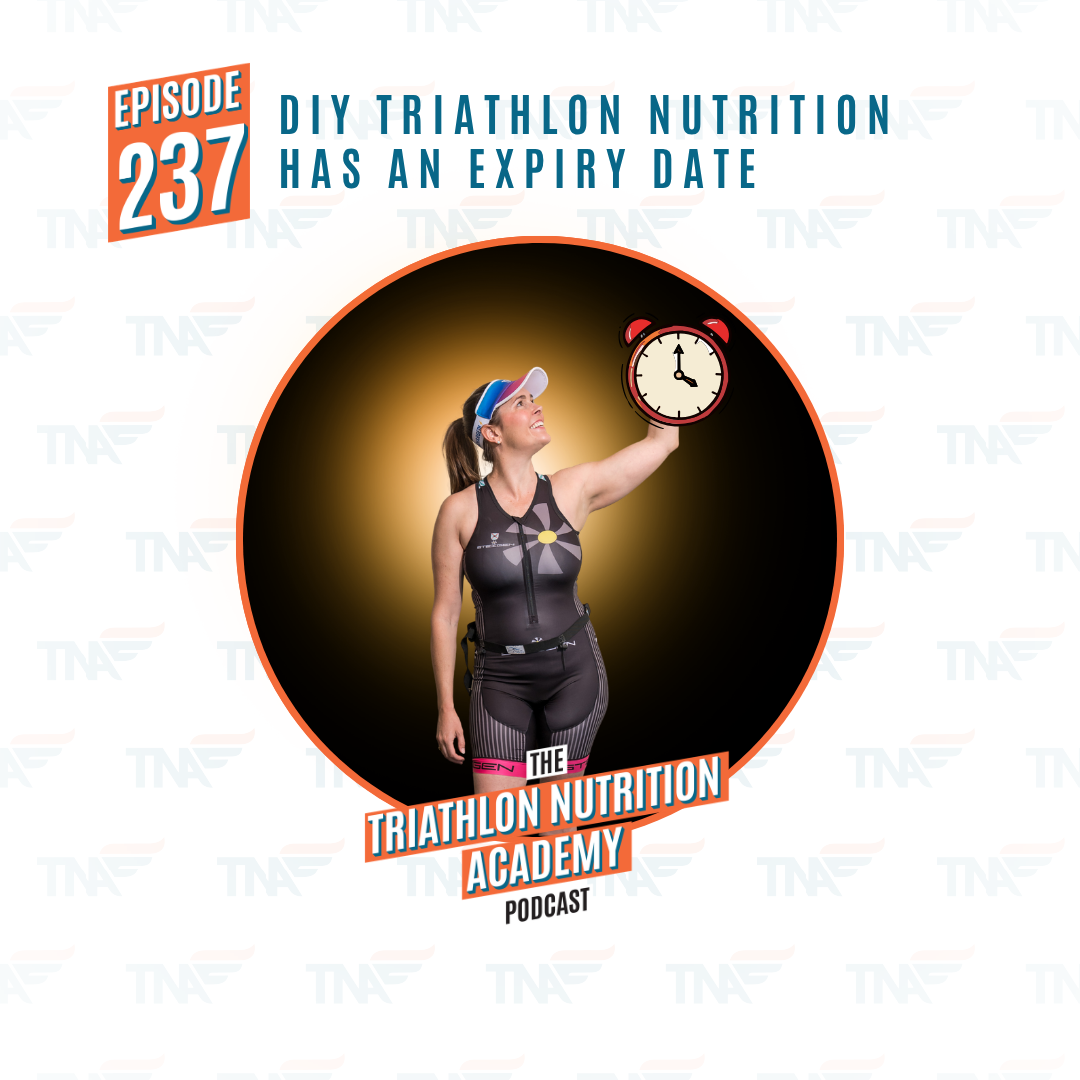
Episode 237 - DIY Triathlon Nutrition Has an Expiry Date

Still Googling your fuelling plan and hoping for the best on race day?
If you’re piecing together your triathlon nutrition from calculators, generic meal plans, training buddies or ChatGPT, you’re not alone. But here’s the truth most age-group triathletes need to hear… DIY nutrition only works for so long.
In this episode, Advanced Sports Dietitian Taryn Richardson breaks down why the DIY approach has an expiry date and what it’s really costing you in performance, time and results. You’ll learn why generic advice can’t keep up with your training load, lifestyle or race goals and how it often leaves athletes stuck, fatigued and frustrated despite training hard.
Taryn shares the most common mistakes triathletes make when trying to figure it out themselves, including relying on online calculators, copying others or following one-size-fits-all plans. She also explains why understanding the “why” behind your nutrition is the key to unlocking better recovery, stronger sessions and race day confidence.
Links:
Check how well you’re doing when it comes to your nutrition with our 50 Step Checklist to Triathlon Nutrition Mastery
Start working on your nutrition now with my Triathlon Nutrition Kickstart course
It’s for you if you’re a triathlete and you feel like you’ve got your training under control and you’re ready to layer in your nutrition. It's your warmup on the path to becoming a SUPERCHARGED triathlete – woohoo!
Connect with me:
To learn more about the Triathlon Nutrition Academy, head HERE | dietitianapproved.com/academy
See behind-the-scenes action on Instagram: @dietitian.approved
Follow along on Facebook: @DietitianApproved
Join our FREE Dietitian Approved Crew Facebook group
Enjoying the podcast?
Let me know what you loved about it and what you learnt by tagging me @dietitian.approved on Instagram!
Subscribe & Review in Apple Podcast!
Are you subscribed to the podcast?
If not, today's the day! I'm sharing practical, evidence-based nutrition advice to help you nail your nutrition and I don't want you to miss an episode. Click here to subscribe to iTunes!
Now if you’re feeling extra warm and fuzzy, I would be so grateful if you left me a review over on iTunes, too. Those reviews help other people find my podcast and quality nutrition advice. Plus they add a little sparkle to my day.
CLICK HERE to review, select “Ratings and Reviews” and “Write a Review” and let me know what your favourite part of the podcast is.
You're awesome! Thank you!
Episode Transcription
Episode 237: DIY Triathlon Nutrition Has an Expiry Date
Welcome to the Triathlon Nutrition Academy podcast. The show designed to serve you up evidence-based sports nutrition advice from the experts. Hi, I'm your host Taryn, Accredited Practicing Dietitian, Advanced Sports Dietitian and founder of Dietitian Approved. Listen as I break down the latest evidence to give you practical, easy-to-digest strategies to train hard, recover faster and perform at your best. You have so much potential, and I want to help you unlock that with the power of nutrition. Let's get into it.
Taryn: If you have a problem with your feet, you go to the podiatrist. If you have a problem with your eyes, you go to an optometrist. If you need heart surgery, you go to a cardiac surgeon. Nobody questions that. Nobody Googles their way through a triple bypass surgery. or watches YouTube for step-by-step instructions on how to do that. And hopes for the best, But for some reason when it comes to nutrition, triathletes go literally everywhere else to every other source possible before seeing a qualified sports dietitian. Today I really wanna talk about why that is, what it's costing you and why at some point that DIY approach runs out a road.
[00:00:42] now, before I get into the why, I want you to ask yourself honestly, if you recognise yourself in any of these behaviours, because most athletes that I work with have done at least three of these things.
[00:00:55] Before they ever come to work with me in the Triathlon Nutrition Academy,
[00:00:58] the first one is piecing together your race nutrition plan from a free online calculator. These are usually built by a supplement company their primary goal is to sell you more products.
[00:01:11] So you put in a little bit of information and it spits out how many gels you need of their product, how much sports drink, potentially, and any other products that they might have in their product range to build your perfect race nutrition plan using only their sports nutrition. Now I have some major problems with that.
[00:01:31] Firstly, it has no context about you, your gut tolerance, your intolerances and preferences, any food allergies, how you're currently fuelling, what you're trying to aim to achieve, how long have you got to practice. There are so many nuances that go into building a custom race nutrition plan for you for that particular event. Not to mention, generally, when athletes have their race nutrition plans dialled in, it might pull from different brands and different products, so they've got a mix of supplement companies where they're getting their gels and sports drinks from. It is not typical for somebody to have only one brand. They stick with that brand for all of the things.
[00:02:14] So I really love to build race nutrition plans with my athletes that are bespoke to them, their fuelling needs, but also their preferences for products. And that can come from a range of different things. So if you have been building your race nutrition plan from a free online calculator, I would suggest that that's only gonna get you so far, and if you do really want to dial it in, then you're going to need to understand all of the nuances that go into your race nutrition plan to build something that is very highly specific to you, and also for that event.
[00:02:48] Another one that DIY athletes do, which is highly problematic, is. Downloading a generic meal plan off the internet and trying to force it to fit into your life. Again, it is generic. It knows nothing about you and your context or your lifestyle, how you like to eat, how you like to do your grocery shopping, how many people in your house you're feeding,
[00:03:08] If you have any intolerances or allergies, if you have any food preferences, again, there are so many things that go into building a unique and bespoke meal plan for you to follow each day based on your training. That just something generic is never going to be able to fit again.
[00:03:24] It'll get you so far, but if you really wanna dial things in, then you're going to need something that's gonna work perfectly for you, not something that's gonna take you six hours to meal prep on a Sunday when you don't have six hours to meal prep on a Sunday because you're out going for a six hour ride instead.
[00:03:39] You want something that is fast, easy, and full of all the right building blocks for you as a triathlete, and that includes more than just protein, carbs, and fats. You also need to think about the beautiful micronutrients that you need in your diet and getting enough fibre to keep your gut microbes happy.
[00:03:56] It's not as simple as just going, yep, this is some random generic meal plan. I'm gonna follow that for a while and see how it goes.
[00:04:03] You might get a couple of days out of it and then it's not gonna work for you long term. So you've just wasted all that time and effort and maybe that excitement to start something new without really having an understanding about. Why it's not working and how to finesse it and change it as things happen.
[00:04:19] You know what if you had to skip a session because you got stuck at work, what do you then do? Do you just keep following this generic meal plan, or do you actually have some knowledge and understanding about how to adapt your nutrition for the rest of the day for. Based on not training or you throw an extra session in, do you know how to adapt your nutrition to support that extra session?
[00:04:39] Do you know how to adjust when you get sick or you get injured or you go on holidays It's not just a throw it all in, you only live once. I'll just eat whatever and then I'll get back into this meal plan when I get home. Like, let's not do that.
[00:04:51] Let's be better than that because we're high performing triathletes. Another one is asking chat GPT to do well pretty much anything with [00:05:00] nutrition. It has a beautifully written answer. It always gives you an answer regardless of what you ask it. Whether you know if that's right or not is another question.
[00:05:09] Some of my athletes are playing around with some wearable hydration and sweat testing sensors at the moment, and feeding that data back through chat GPT and being like, Hey, what's the deal? What's my hydration strategy? And the output from that, which we've all shared in our power hour sessions is laughable.
[00:05:25] But these guys know exactly what they're looking for. they know what levers to pull for their hydration, their sodium, the overall hydration plan. And so they have the knowledge to critically evaluate that and go, that's not right, or that's sort of right, but you went a bit haywire there.
[00:05:41] And if you don't understand all of that, that goes into your hydration plan, then newsflash ChatGPT's not gonna know that either, or how to tweak it and finesse it based on you and your needs. This is a good one, and I'm pretty sure everyone has done this at some point. Googling what to eat before training, how many carbs to have per hour, how do you carbohydrate load? What is gut training, how to do it. Tell me, help me fix it. Give me the answers, Google, and I'll do whatever you tell me. You will get a generic answer with zero context about you if you are Googling your nutrition strategy.
[00:06:19] This is, again, the problem with AI at the moment is it's giving you answers, but it doesn't have the critical thinking and the reasoning. Behind those answers to pull all of the bits and pieces that it might know about you or your sports dietician can learn about you to provide an answer that is contextualised to you and your situation.
[00:06:40] And that is the fastest way to fail when it comes to DIY, because you'll do something and then still have no understanding around why we do the things and how to apply it to you and your situation, and then how to adjust that plan when something changes.
[00:06:57] I am still going here. This list is ginormous, but asking your coach, your training buddy, your partner, whoever it is, all of them are very well-meaning all of them will give you advice, but none of them are qualified to provide it
[00:07:10] and they have probably figured out what works for them or a lot of. Companies approach teams and coaches to sponsor them with particular brands of sports nutrition. And so they might be recommending the one type of sports nutrition product as the best. But whether that's right for you or not is another question.
[00:07:30] So while these people mean well, and they're probably your closest knit circle, unless they've done a degree in sports nutrition, then you're probably better off investing in. Again, the education from the right place rather than going to your podiatrist to get your eyes or vice versa. And finally pulling nuggets from podcasts. Yes. Even this one, although I keep all of my good nuggets for my Triathlon Nutrition Academy athletes and trying to piece those together into something that is coherent and is going to work for you, it's gonna take you so much longer. If you're trying to do that, like yes, there'll always be nuggets from whatever you're doing and whatever you're listening to, but that is the slowest way to get to an end point than if you just got the right information from the beginning.
[00:08:17] I wanted to share a quick example with you of Sarah who has come through the TNA program.
[00:08:23] You can go back and hear more about Sarah's story on Episode 212 of the podcast if you are interested. But Sarah is a self-professed back at the packer. She was bonking in every Olympic distance race that she was doing because she was following generic advice. That had nothing to do with her body, her training, her stress load and her life,
[00:08:45] and she shared really openly about how she no longer bonks in Olympic distance events. She understands how to fuel and periodise her nutrition to training, which she's never done before. She comes from a dieting car phobic background, and so she eats the same and rhythmically across the week and she's got a really good system for that.
[00:09:05] But now she knows how to add periodisation into her system so that she's eating to support her training load. And that is a difference between. Getting generic advice or following non triathlon specific advice, and then getting triathlon specific advice from an advanced sports dietician. So here's the thing with DIY nutrition, and I wanna be fair here. It is not stupid. It's not the worst idea ever. Some of it works and it's gonna work for a short period of time. Like you'll get a while out of it potentially. But the problem is it has an expiry date. It doesn't have longevity, and most athletes don't really realise that they've hit that ceiling until they're standing at the start line of a race, wondering why nothing's really changed, why they're not getting any faster, why they're not getting any leaner.
[00:09:53] Why they're still feeling so fatigued all the time and you get to the peak of a training block and you are so tired and you just want the damn thing to be over.
[00:10:01] That's not normal, let me tell you. And there's definitely a better way to do it. So generic advice absolutely can get you started. If you're starting from grassroots, zero rock bottom, no idea what you're doing. but it can't evolve with you.
[00:10:16] It doesn't know your genetics, your body composition, your goals, your stress levels, your lifestyle. It doesn't know any of your medical history and how to apply nutrition to get the most out of your body. It also doesn't know what you do in a day. Like there's this saying that we all have the same 24 hours in a day. Lemme tell you, as a mom of three small children, we do not have the same 24 hours in a day, and generic advice doesn't know that about you.generic advice can't adapt when your race distance changes. If you jump from sprint and Olympic distance and you wanna dabble in long course and do your first 70.3 or do your first Ironman, it's not going to adjust and adapt for you to support that increase in training load.
[00:11:04] Generic doesn't understand when a new health issue comes up.
[00:11:07] Or you add an extra training session to your day
[00:11:10] or your life shifts. I have a great example of one of my TNA athletes, Kathleen, who started with a new coach Ended up doing double session training days in a day for the first time ever. Now, if you are following a generic plan, you would have no idea that that was no longer going to serve you when you were training twice a day.
[00:11:30] but because Kathleen knows how to do her pre-training nutrition. Her recovery nutrition, she knows how to do her fuelling based on what type of training session it is and how to periodise her food to training. She can very quickly adjust her nutrition to support that extra session in a day rather than struggling and falling you into a hole and feeling like a tired triathlete with the extra volume of training Free information on the internet is very static. You are not. You are a rapidly evolving human. You're doing things differently. You are changing your training. You're going on holidays. Maybe you're changing work structure. You're retiring, your health is changing. Females, our hormones are changing. We are not static and set and forget. Our nutrition needs to constantly evolve. And the only way to do that is to understand all of the information that goes into what makes up nutrition that's uniquely you.and this is exactly where having structured guidance becomes a game changer. When your nutrition is built around you, your body, your training load, your goals, your life,
[00:12:36] it can evolve with you when your race distant changes, it changes with you. When life gets messy, as it invariably will, it changes and adapts with you. And that's what working with an expert gives you that Google or AI never will, and it's exactly what the Triathlon Nutrition Academy program is designed to do.
[00:12:56] If that sounds like what you've been missing, there is a link below this to go and check out the academy, and I'll talk a little bit more about it at the very end of this episode.
[00:13:05] So let's talk about what it costs you to keep going at it alone. And I don't just mean the financial cost, I mean also time, your performance And the years you're going to spend or you are spending fumbling around in the dark, not knowing whether what you're doing is actually working for you or not,
[00:13:24] it will take you 50 times longer, not exaggerating. To get to the same outcome Compared to investing in proper support once you only have to do it once. It's not an ongoing forever thing. if you understand everything about triathlon nutrition, you have that education to draw on.
[00:13:45] You don't need to relearn it. You also cannot troubleshoot what you don't understand. If you have no idea what goes into your race nutrition plan, and you've been handed one, how are you going to adjust it? If. The race is way hotter than it was predicted to be, or you've done the bike way faster than predicted. And so what do you do with all this extra fuel that you're carrying?
[00:14:09] Do you just cram it in the end or do you leave it? And then what do you do for the run? What do you do with your race nutrition plan if you are walking more than you thought you were and your run is blowing out?
[00:14:21] What are you going to do if you have a perfectly planned carbohydrate loading plan that somebody has given you and you can't get access to all the foods that are on it When you're traveling,
[00:14:31] if you don't understand the pieces and components that go into that, you are stuck with whatever's been provided or whatever generic advice you've pulled off the internet. You don't know what you don't know, and that is the most dangerous place to be when it comes to nutrition. The athletes that are doing the best and performing to the best and are the healthiest and have better longevity in our sport are the ones that actually. Have educated themselves on [00:15:00] nutrition and properly because it really is the fourth leg of triathlon you need to swim, bike, and run.
[00:15:05] But to do those three things well, you also need to layer in all of your nutrition principles around that so you can adapt from training because you only get fitter and faster. You only adapt from the training that you recover from. So if you are burning the candle at both ends and haven't got your nutrition around your training, then you're almost doing junk miles.another cost to you is that there is no feedback loop. You have no way of knowing that what you are currently doing is actually working. Or if you are just coasting along and just getting by, when you have feedback and you know what signs to look for and you have a brain from a real human to get feedback from and analyse situations and provide guidance around the things to try to move forwards and get better, then that is the easiest way to get fitter and faster. With DIY, you don't have that progression that every triathlete I've ever met wants without understanding the why. You do stay stuck at that same level and not getting slower, but you may not be getting any faster either. And for a high performing triathlete. That's quite frustrating. I once had a training buddy, say at the start of a ride, it was like five o'clock in the morning and it was dark and he said, I wish I could just wake up and be good at triathlon.
[00:16:30] Now the way to do that. Is work on your nutrition. It is the single thing aligned with training properly that is gonna make you better at triathlon. But so many of us just don't respect that. We think if I just train more, I will get better. But if you don't have your nutrition right, you're not gonna get better and it's
[00:16:51] no amount of Googling is gonna give you two decades of clinical experience working with thousands of triathletes.
[00:16:58] And no amount of Googling is going to give you six years of university level study in nutrition. When we have so many armchair experts and everyone thinks they're an expert in nutrition, unless you've done multiple years of higher tertiary level study, then how can you say that you're an expert? You might be an expert in you and your body, but that does not give you the right or the privilege to provide nutrition advice to others.
[00:17:27] In fact, in Australia, you cannot. The term dietitian is highly regulated. Anyone can call themselves a nutritionist, but you cannot call yourself a dietician without going through a whole heap of hoops to do that. And then maintaining professional insurance so that we don't f people up, as well as a whole heap of integrity things, including lots of things we just cannot do, whereas any person on the internet can go spreading advice. But dieticians are highly regulated and controlled, which is why you won't see us do certain things. 'cause we're literally not allowed to. We will lose our license to be a dietician if we do. When you actually understand your nutrition, not just follow a plan that's been given to you, or you've put off the internet, but you actually understand what goes into it. Everything changes. You stop fumbling around in the dark, you stop winging it. You stop throwing spaghetti at the wall and hoping something sticks.
[00:18:24] You stop Googling things at 9:00 PM on the night before your race because you got worried about something you heard at the expo. You stop being the athlete who has tried every single gel, every supplement, every crazy diet, and you're still not sure. What's working and what isn't working. You've tried keto, you've gone vegan for a bit.
[00:18:46] Maybe that was after you went paleo and had a complete switch. You've gone low carb, high fat. There's always going to be something noisy there, particularly marketed to endurance athletes. We seem to be a ready market that will just do anything that they see.
[00:19:03] But you need to understand your specific nutrition for you to push the needle forward. And when something changes in life, You know exactly how to adapt. And that could be a different race distance. It could be a new health issue. Like Julia, who we heard on the podcast a couple of weeks ago, I called it.
[00:19:21] Last year. But um, I thought she had some thyroid issues and it's only now that she's been diagnosed with Hashimoto's, but because she has access to me every week in powwow, we are working through that and rapidly so that she is not up at nine o'clock at night trying to Google what to do or still unsure how to eat or what are the big rocks she needs to look at to improve that for herself. If you switch coaches like Kathleen did, and you suddenly end up with extra sessions or different types of training or different styles of training, you know how to adjust your nutrition to support that you understand the principles, not just the prescriptions, not just the outputs from GPT so that you can troubleshoot things yourself if they're not working.
[00:20:05] You know how to identify if something is working and it's not working. And your nutrition is going to evolve with you
[00:20:11] instead of being something that you just have to start from scratch every new season, and you're like, all right, I'm back on the bandwagon.
[00:20:17] I'm back on this plan. I'll do that until I do my race, and then I'll switch off again. when you understand your nutrition, you become the athlete that goes into race day And toast the start line with a plan that you've built. You've tested it and you trust it completely so that you can concentrate on going hard and your pacing and your mindset and your heart rate and your breathing and all those things that you can do to negative, split the run and not blow up or have horrific GI issues because you're using a different product that you haven't trialed before.
[00:20:51] so I wanna be clear about something before I wrap up. And apologies. This was a little bit ranty and, sorry, not sorry, I'm not having a go at you for DIYing it. Most triathletes do that to some extent because nobody tells them that there is a better way or shows them how to do it or that a better way even exists.
[00:21:11] It's just part of what we do. Thank God for YouTube 'cause it shows you how to fix, you know, change a tire if you need to know how to do that, information is everywhere to us. If you are watching YouTube, listening to podcasts, reading blogs, then maybe it feels like that's enough. And then hiring a sports dietician to work with you can feel like an indulgence and a cost that you don't really wanna spend on yourself rather than a necessity. But there is a faster, cleaner way to do this one where you're not piecing together advice from 17 different sources and just hoping it all adds up and works out on race day
[00:21:50] One way you actually understand why you're doing it, what you're doing, and how to do it specifically for you so that when something changes and it always [00:22:00] does, you know exactly how to adjust that plan. One way you go into every race with a plan that is built for you, tested, and you trust it completely. If you wanna get faster, if you wanna feel better, if you wanna get leaner, if you wanna stop guessing and stop wasting years on approaches that have an expiry date,
[00:22:20] then at some point you have to stop piecing it together and actually invest in getting it right. You only have to do that once. That is exactly what the Triathlon Nutrition Academy is built to do. If you go to dietitianapproved.com/academy or head to the link below, come and join us. I would love to work with you so you can get this right forever.
Thanks for joining me for this episode of the Triathlon Nutrition Academy podcast. I would love to hear from you. If you have any questions or want to share with me what you've learned, email me at [email protected]. You can also spread the word by leaving me a review and taking a screenshot of you listening to the show. Don't forget to tag me on social media, @dietitian.approved, so I can give you a shout out, too. If you want to learn more about what we do, head to dietitianapproved.com. And if you want to learn more about the Triathlon Nutrition Academy program, head to dietitianapproved.com/academy. Thanks for joining me and I look forward to helping you smashed in the fourth leg - nutrition!